Bind Rune Tattoo: Permanent Runic Marks and Their Meaning
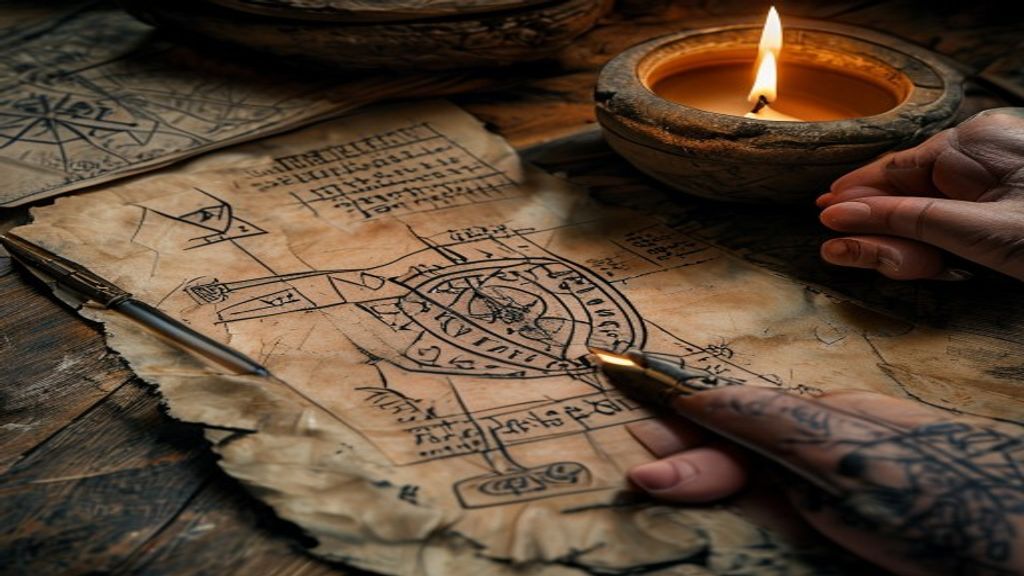
The bind rune tattoo is one of the most consequential decisions a practitioner of the runic arts can make. Unlike a carved amulet that can be set aside, or a drawn stave that can be burned in a closing ritual, a tattoo permanently bonds a symbolic working to the body — the living vessel of the practitioner's energy, consciousness, and breath. This is not a decision approached lightly in the serious runic tradition, and the historical and archaeological record supports that weight. From the enigmatic tattooed figures depicted on Norse-era artefacts to the Eddic poems' insistence that runic knowledge must be earned before it can be wielded, the body has always occupied a unique position in runic cosmology: it is both the instrument of magical practice and the most intimate of all possible carving surfaces. This article examines the body as sacred parchment in the Norse tradition, the genuine ethical framework the tradition offers for permanent runic marks, the doctrine of power points that governs placement, the practice of signing with runic hand marks, and the little-discussed question of what happens when a tattooed rune begins producing results the practitioner did not intend.
The Sacredness of Skin: The Body as Living Parchment
The Norse conception of the body is inseparable from the broader cosmological framework of the Elder Futhark tradition. In the Eddic account of human creation preserved in the Völuspá, Odin and his brothers Vili and Vé fashioned the first humans — Ask and Embla — from two trees found on land. Odin granted them önd (breath, vital force), Vili gave them óðr (consciousness, inspired thought), and Vé bestowed upon them lítu góða — good colour and warm appearance. The human body, in this framework, is not a container for the soul but a primary expression of the vital forces that animate existence. It is material that has been deliberately shaped and endowed by divine intention.
This cosmological framing has direct implications for the practice of body marking. To carve or tattoo a rune onto living skin is not merely decorative — it is an act of deliberate re-inscription of the body's divine composition. The Norsemen were not unfamiliar with permanent body marking as a symbolic practice. The Arab traveller Ahmad ibn Fadlan, who documented his encounter with Norse Rus traders on the Volga in 921–922 CE, recorded that the men bore extensive tattoos from fingernails to necks — described as dark blue figures of trees and other forms. While his account does not specifically identify runic content, it confirms that permanent body marking was part of the cultural vocabulary of the Norse world.
The Eddic corpus reinforces the body's sacred status in magical practice. In the Sigrdrífumál, the Valkyrie Sigrdrífa instructs the hero Sigurðr on the proper domains and inscriptions of runes — ale-runes on a drinking horn, victory-runes on a sword, birth-runes on a woman's palms during childbirth, branch-runes on a tree. The enumeration of surfaces is itself a taxonomy: each material carries different properties that interact with the runic working. Skin — living, breathing, continuously renewed — is the most dynamic of all surfaces. A rune inscribed on it does not sit inert but moves with the body, breathes with it, metabolises with it. The practitioner carries a living working wherever they go.
This understanding should be the first consideration for anyone approaching a bind rune tattoo: the skin is not a canvas in the sense of a neutral receiving surface. It is an active participant in whatever symbolic system is impressed upon it. The tradition's seriousness on this point is not superstition but a coherent consequence of a world-view in which material, form, and intention are continuously interacting.
Ethics of Permanent Marks: Understanding Before Inscribing
The question that serious practitioners of the runic tradition ask before any permanent body marking is not "which rune looks most impressive?" but rather: "Do I understand this symbol sufficiently to live with it for the rest of my life?" This is not rhetorical caution — it reflects a concrete concern rooted in the structure of runic symbolism itself.
Each Elder Futhark rune is a complete archetypal force with a full range of expression. Hagalaz (ᚺ), the hail rune, governs disruption, the radical clearing of stagnant patterns, and the fertile chaos from which new order emerges. In contexts of deliberate working, this energy is transformative — the practitioner chooses to invite controlled disruption to break free of limitations. As a permanent tattoo on the body of someone who has not deeply considered all dimensions of Hagalaz's influence, the rune may produce exactly what it always produces — disruption — in contexts and relationships the practitioner did not intend to clear. This is not supernatural punishment. It is the consequence of embedding a concentrated symbolic attractor into one's energetic field without a clear framework for directing its expression.
"Runes are not merely symbols — they are living forces that interact with the practitioner's will, environment, and intention. To carve them is to invite their active presence into one's life." — Edred Thorsson (Stephen Flowers, Ph.D.), Runelore: A Handbook of Esoteric Runology (1987)
The ethical framework the tradition offers is one of proportionality: the depth of understanding required is proportional to the permanence of the inscription. A bind rune drawn on paper for a temporary working requires less thorough knowledge than one carved on a wooden amulet worn for a season, which requires less than one tattooed permanently on the body. For a tattoo, the tradition asks that the practitioner:
- Know each component rune individually — its name (in Old Norse), its domain across the three Elder Futhark runic poems, its historical archaeological appearances, and its shadow dimensions
- Understand the stave's composite meaning — how the runes interact symbolically, what hidden runes their geometric combination might generate, and how the combined force relates to the practitioner's sustained values rather than a temporary goal
- Design the stave with intentionality — not simply choosing runes for their isolated meanings but considering how they interact visually and symbolically as a geometric unity; see our guide on how to make a bind rune for the full compositional process
- Test the design as a temporary working first — drawing the stave, working with it for a period, noting its effects before committing it to skin
- Perform a formal activation ritual at or after the tattooing, consciously initiating the energetic relationship with the inscribed forces
The concern raised in contemporary discourse about rune tattoos — "are rune tattoos bad luck?" — conflates the rune with misfortune in a way the tradition does not support. The runes themselves are not bad luck. Careless, uninformed, or indiscriminate use of any concentrated symbolic system — including permanent body inscription — creates unpredictable results. The remedy is not avoidance but knowledge.
Power Points on the Body: Placement by Energetic Correspondence
The Norse tradition did not develop the elaborate chakra-system of South Asian practice, but it did articulate a systematic understanding of the body's energetic structure — one most completely preserved in the esoteric runological tradition. The placement of runic marks on specific body locations is not arbitrary but follows a geography of symbolic correspondence between rune domains and body functions.
The tradition recognises several primary power centres on the human body, each corresponding to clusters of runic influence. These correspondences derive not from later folk additions but from the internal evidence of the Eddic corpus and the runic poems themselves, which connect specific runes to specific bodily acts and locations.
| Body Location | Corresponding Domain | Runes of Affinity | Traditional Function |
|---|---|---|---|
| Hands and fingers | Will, craft, action | Tiwaz (ᛏ), Raidho (ᚱ), Kenaz (ᚲ) | Signing, gestic magic, skilled work |
| Chest and sternum | Core protection, courage | Algiz (ᛉ), Thurisaz (ᚦ), Sowilo (ᛋ) | Defensive shield, warrior's heart |
| Upper back and shoulders | Boundary, ancestral protection | Othala (ᛟ), Algiz (ᛉ), Isa (ᛁ) | Defence against unwanted energies from behind |
| Arms and forearms | Strength, endurance, directed force | Uruz (ᚢ), Tiwaz (ᛏ), Eihwaz (ᛇ) | Physical and volitional power |
| Throat and collar | Voice, word, communication | Ansuz (ᚨ), Kenaz (ᚲ), Wunjo (ᚹ) | Galdr, speech, truthful expression |
| Spine and ribs (hidden) | Deep transformation, the hidden self | Perthro (ᛈ), Hagalaz (ᚺ), Nauthiz (ᚾ) | Inner journey, shadow work, fate |
| Feet and ankles | Path, journey, grounding | Raidho (ᚱ), Ehwaz (ᛖ), Jera (ᛃ) | Direction, safe passage, life journey |
This correspondence table is not prescriptive in an absolute sense — the practitioner's intuitive relationship with their own body and its energetic needs should inform the final decision. But the traditional correspondences provide a reasoned framework that transforms placement from an aesthetic choice into a considered symbolic act. A Tiwaz–Uruz bind rune placed on the forearm — close to the hand of action — speaks differently than the same stave placed over the chest, where it resonates with the warrior's heart rather than the craftsman's directed will.
The Magic of Gestures: Signing and Runic Hand Marks
Among the most practically significant aspects of runic body marking is the practice known as signing — the deliberate tracing of rune forms in space as a gestic magical act. The practitioner draws the rune through the air with the hand, inscribing it into the environment, onto objects, or into specific spatial relationships. This practice has deep roots in the Eddic tradition: in the Skírnismál, the god Freyr's messenger Skírnir carves a thurs (Thurisaz) stave on a staff directed at the giantess Gerðr as an act of binding. In the Sigrdrífumál, victory-runes are named and signed onto a sword's blade — the physical carving is preceded and accompanied by the naming and gestic signing of the rune's force into the object.
When a rune or bind rune is tattooed on the hand — particularly on the back of the hand, the fingers, or the inner wrist — the act of signing becomes the most integrated possible expression of that rune's force. The practitioner does not merely draw the rune through the air with a neutral hand; they extend and project the inscribed force from the very location where it is permanently embedded. The tattoo becomes the origin point of the signing motion, and the signing motion activates the tattoo. This creates a feedback loop between the permanent inscription and the repeated living gesture that is qualitatively different from the same signing performed with an unmarked hand.
The runes most commonly chosen for hand placement in the serious tradition are those whose domains directly correspond to action, craft, directed will, and communication — the functions of the hands themselves:
- Tiwaz (ᛏ) — justice, disciplined will, the act of choosing rightly under pressure. Placed on the sword hand in historical warrior contexts; on the dominant hand today for practitioners of any discipline requiring integrity and directed effort.
- Kenaz (ᚲ) — the controlled flame of craft, illumination, and skilled knowledge. Traditional mark for smiths, artists, healers, and craftspeople working with fine tools.
- Raidho (ᚱ) — the rune of the right path, journey, and rhythm of purposeful motion. Placed on hands that navigate — in the literal sense of steering or guiding, or in the metaphorical sense of leading and directing.
- Ansuz (ᚨ) — Odin's breath and the power of the spoken word. Associated with practitioners for whom the voice and written word are primary instruments — writers, teachers, orators, counsellors.
For bind rune tattoos on the hands, the principle of compositional restraint is especially critical. The hand is a small, complex surface in constant use and view. A two-rune bind rune — Tiwaz and Kenaz for a craftsperson seeking disciplined creative mastery, or Raidho and Ansuz for a writer seeking both direction and inspired speech — is almost always more effective and aesthetically coherent than a complex multi-rune stave on a limited surface.
Deactivation: When a Tattoo Begins Working Against You
This is the dimension of runic tattoo practice that popular discussions consistently omit, and its omission leaves practitioners unprepared for a genuine possibility. A bind rune tattoo, properly activated, creates an ongoing energetic relationship with the forces it encodes. Like any sustained relationship, it can evolve in directions the practitioner did not initially foresee — particularly when the practitioner's own life circumstances, values, or needs change significantly from those that motivated the original working.
A Nauthiz (ᚾ) tattoo — the rune of need, constraint, and the friction that generates growth — chosen during a period of creative stagnation may have served its purpose by the time the practitioner has broken through into a phase of abundance and expansion. The rune does not automatically "turn off." Its symbolic attractor continues to function, potentially now generating unnecessary friction in a life that has moved beyond the phase of productive struggle. This is not the tattoo "going bad" in any supernatural sense. It is the consequence of a permanent symbolic working being applied to a temporary condition.
The tradition addresses this through what can be called a formal deactivation or unlinking ceremony. The components are:
- Formal acknowledgement — the practitioner explicitly recognises that the working is complete and thanks the runic forces for their service, addressing each component rune by its traditional name.
- Reversal of activation — the original activation was typically performed by tracing the stave, naming its runes, and breathing Önd (intentional breath) into the symbol. Deactivation reverses this: the practitioner traces the stave in reverse, names the runes in reverse order, and performs a conscious withdrawal of the animating breath.
- Closing ritual — smoke cleansing with juniper or yarrow (both attested in Nordic ritual contexts), followed by a clear verbal statement that the working is dissolved and the energetic relationship with the inscribed forces is formally closed.
- Physical integration — the tradition recommends aligning the inner and outer states, which in practical terms means either covering the tattoo (through clothing, bandage, or eventually a new tattoo over it) or physically modifying it. A working that has been energetically deactivated but remains physically prominent continues to draw attention and invite renewed engagement.
It is worth noting explicitly: this process is a closing of one specific intentional working, not a condemnation of the rune itself. Tiwaz does not become an enemy because the practitioner's relationship with its domain of disciplined justice has changed. The rune remains what it always was. The practitioner simply closes the specific activated relationship they had established with it through the tattoo.
Choosing Your Design: A Practitioner's Framework
Given the stakes of a permanent runic mark, how does a practitioner approach the design process wisely? The tradition's accumulated guidance points to a structured process that prioritises depth of understanding over speed of execution.
Begin with the intention, not the rune. Rather than browsing Elder Futhark reference charts looking for symbols that seem appealing, the serious practitioner starts with a clearly articulated intention: "I seek to cultivate sustained creative discipline in service of meaningful work" rather than "I want something that means strength." The former leads naturally to a specific runic combination (Kenaz for creative fire, Tiwaz for disciplined will, perhaps Wunjo for joy in purposeful work) — the latter leads to a generic Uruz that may not accurately represent the practitioner's actual need.
Then research each rune individually in primary and scholarly sources: the Old Norse runic poems (Rúnatal, Norwegian Runic Poem, Icelandic Runic Poem), R.I. Page's archaeological analyses, and Thorsson's systematic esoteric runology. Understand not only what each rune governs in its most positive expression but also what it governs in its full range — including its shadow dimensions and what happens when its energy is expressed without conscious direction.
After identifying the component runes, design the stave as a geometric unity. This is where the Bindrune Creator canvas becomes an invaluable tool. The digital canvas allows the practitioner to experiment with different geometric configurations — testing how the runes share strokes, whether the resulting hidden runes (if any) are compatible with the intended working, and whether the visual harmony of the combined stave matches the symbolic harmony of its components. Iterate the design over weeks or months, living with it as a temporary drawn or printed stave before making any permanent commitment.
When the design is settled, choose a tattoo artist who understands runic forms with geometric precision. A bind rune's power depends partly on the geometric integrity of its form — the correct angles, the proportions of staves and arms, the precise meeting of overlapping strokes. An artist who works confidently in geometric linework, ideally with some familiarity with Elder Futhark letterforms, will produce a more symbolically accurate result than one accustomed to ornate decorative styles.
Before committing to permanent ink, design and refine your bind rune tattoo digitally. The Bindrune Creator canvas lets you compose Elder Futhark staves with precision — testing geometric configurations, identifying hidden runes, and finding the exact design that matches your intention.
Design Your Bind Rune →Frequently Asked Questions
Is it disrespectful to get a bind rune tattoo?
A bind rune tattoo is not inherently disrespectful, but permanence demands proportional understanding. The tradition holds that marking the body with a runic stave creates an ongoing energetic relationship with those forces. Taking the time to study the individual runes, understand their combined meaning, and design the stave with genuine intent respects the tradition and serves the practitioner's own interests. Copying a design without understanding its component runes, by contrast, creates an uncontrolled symbolic relationship on the body — which is the concern serious practitioners raise.
Are rune tattoos bad luck?
The tradition does not categorise rune tattoos as inherently bad luck. The concern is improper composition: runes whose combined meaning works against the practitioner's stated intention, or the accidental creation of hidden runes through overlapping strokes that introduce unintended symbolic elements. A properly composed, clearly intentioned bind rune tattoo is understood as a permanent ally. The risks arise from carelessness or misunderstanding, not from runic marks themselves.
What are the best runes for a tattoo?
The best runes for a tattoo are those whose meanings align authentically with the practitioner's sustained values, not temporary moods. Algiz (ᛉ) for protection, Tiwaz (ᛏ) for justice and disciplined will, Sowilo (ᛋ) for solar clarity and purpose, and Berkano (ᛒ) for nurturing strength are among the most frequently chosen for permanent marks precisely because their domains remain relevant across a lifetime. The choice should be made slowly, with full knowledge of each rune's attested meanings across the Elder Futhark runic poems.
What is "signing" with runic hand tattoos?
Signing refers to the practice of tracing rune forms in the air with the hand as a gestic magical act — a form of galdr in which the practitioner's body becomes the instrument. When the relevant rune or bind rune is tattooed on the hand or fingers, the act of signing integrates symbol, gesture, and body into a single unified expression of intent. This practice has attested precedents in the Norse tradition of Tyr-runes for battle preparation and the Valkyrie instructional poems in the Eddic corpus.
Can a runic tattoo be spiritually deactivated if it causes problems?
The tradition acknowledges this possibility through a formal banishing or unlinking ceremony. The practitioner formally addresses the rune by name, states clearly that the energetic bond is dissolved, and performs a closing ritual — typically involving the reversal of the original activation sequence. This does not physically remove the tattoo but is understood as severing the intentional working relationship. Most practitioners then proceed to cover or modify the design physically as well, aligning the outer and inner states.
How do I choose the location for a runic tattoo on my body?
Location selection in the runic tradition is based on the correspondence between the rune's domain and the body's energetic centres. Protective runes (Algiz, Thurisaz) are placed on the chest, upper back, or shoulders. Strength runes (Uruz, Tiwaz) find natural resonance on the arms and hands. Runes related to the voice (Ansuz, Kenaz) are placed near the throat. Runes of transformation and inner journey (Perthro, Hagalaz) are placed in interior, hidden locations — the ribs, the spine — close to the body's concealed core.
Should I design my own bind rune tattoo or use an existing design?
The tradition strongly favours personal composition over copying existing designs. A bind rune tattoo is most effective when composed for the specific practitioner's intent, because the act of deliberate design is itself the first stage of activation — the moment intention is crystallised into form. Using the Bindrune Creator canvas to design and iterate your own stave before committing to permanent ink is precisely the approach the tradition recommends: compose with knowledge, refine with care, then commit.