How to Make a Bind Rune: Step-by-Step Guide for Beginners
Learning how to make a bind rune is not simply a design exercise — it is the practice of composing a structured relationship between symbolic forces drawn from one of the oldest documented writing systems in the Germanic world. If you are new to the concept, start with what a bind rune is and the tradition it comes from. The Elder Futhark's 24 runes each carry phonetic, symbolic, and numerical weight, and when two or more are geometrically merged into a single stave, the resulting ligature is simultaneously a word, a number, and a visual argument. The historical record is clear: bind runes appear on 5th-century Scandinavian bracteates, Viking Age amulets, and the elaborated galdrastaves of 17th-century Icelandic manuscripts — always at moments of concentrated symbolic need. This guide presents the complete process of creating a bind rune from first principles: formulating a precise intention, selecting runes through a structured method, understanding the geometry of stave architecture, applying rules of graphic harmony, and walking through the construction of the classic Gibu Auja stave — the "luck-giver" formula attested in archaeological finds from 6th-century Scandinavia. By the end, you will have both the conceptual framework and the practical method to compose your own bind runes with the same rigour as the carvers who first cut these symbols into stone.
Formulating Intent: The Foundation Before Any Rune Is Chosen
Every bind rune in the historical record has a legible purpose. The Kragehul lance shaft (c. 500 CE, Denmark) carries a galdr-formula directed at warding the weapon in battle. The Seeland-II-C bracteate bears the Gibu Auja formula as a specific wish — not "general good," but the active gifting of luck. The Icelandic Galdrabók (c. 1600) precedes each stave design with an unambiguous statement of application. This is not coincidence: the historical practice demonstrates that a bind rune without a precise intention is not a working tool — it is an unfinished object.
Modern runological practice, grounded in the scholarship of Stephen Flowers (Edred Thorsson, Ph.D., University of Texas 1984), frames intent-setting in explicitly psychological terms. In Futhark: A Handbook of Rune Magic (1984), Flowers describes the act of formulating intention as the structuring of will into a form that can be expressed symbolically — a process that forces clarity by demanding that the practitioner identify exactly which domain of experience they are working within, what outcome they are directing attention toward, and by what symbolic logic the chosen runes connect to that outcome.
The practical method is this: before touching any rune reference, write your intention in a single declarative sentence. Not "I want better luck" but "I direct energy toward increasing the flow of opportunities in my professional work." Not "I want protection" but "I seek to establish an active and conscious boundary against destabilising external forces." The more specific the sentence, the more precisely you can identify which Elder Futhark runes belong in your composition. Vague intentions produce vague staves; precision produces power.
Once you have your sentence, identify the key concepts it contains — typically two or three domains of experience. These become your search criteria for selecting runes in the next step. The intention statement is not discarded after rune selection: it is returned to at every subsequent stage — choosing the stave architecture, finalising the graphic composition, and performing the activation galdr — to ensure the final symbol remains true to the original working.
Choosing Your Runes: The Three Circles Method
The Elder Futhark contains 24 runes, each with a distinct symbolic domain established by the Old Norse runic poems: the Rúnatal, the Hávamál's runic stanzas (138–145), and the three surviving runic poem texts (Icelandic, Norwegian, and Anglo-Saxon). Selecting runes for a bind rune requires more than matching keywords — it requires understanding how each rune operates and whether the runes you are considering will support or conflict with each other's symbolic domain.
The Three Circles method provides a structured framework. Draw three concentric circles. In the innermost circle, place runes that directly name your primary intention — the rune whose core meaning is your goal itself. In the middle circle, place runes that support, amplify, or direct that primary force toward your specific context. In the outer circle, place runes that could potentially conflict — whose symbolic energy runs counter to your intention — so they can be consciously excluded.
For a working intended to strengthen disciplined creative output, the inner circle might contain Kenaz (ᚲ) — the rune of the controlled flame, craft, and illumination — as the direct expression of creative skill applied with focus. The middle circle might contain Ansuz (ᚨ) — divine inspiration and the power of the spoken or made word — as an amplifier of creative force. The outer circle would flag Isa (ᛁ) — stasis and suspension — as a force that, merged carelessly with Kenaz's active heat, could produce a symbol that simultaneously ignites and freezes the creative faculty.
"The runes are not mere signs or symbols — they are themselves things with powers. Working with them therefore requires the practitioner to understand them as forces with their own natures, not as inert ink-marks assigned meanings by convention." — Edred Thorsson (Stephen E. Flowers), Runelore: A Handbook of Esoteric Runology, 1987
For beginners, the most important rule is restraint: use two or three runes, no more. Each rune carries a full archetypal domain. A bind rune of two runes creates a dyadic relationship — a dialogue between two symbolic forces that modifies and amplifies both. A third rune mediates, qualifies, or bridges that relationship. Beyond three, the symbolic relationships multiply faster than they can be consciously governed, and the geometric complexity creates increasing risk of unintended hidden rune forms in the overlapping strokes.
Stave Architecture: Linear and Radial Forms
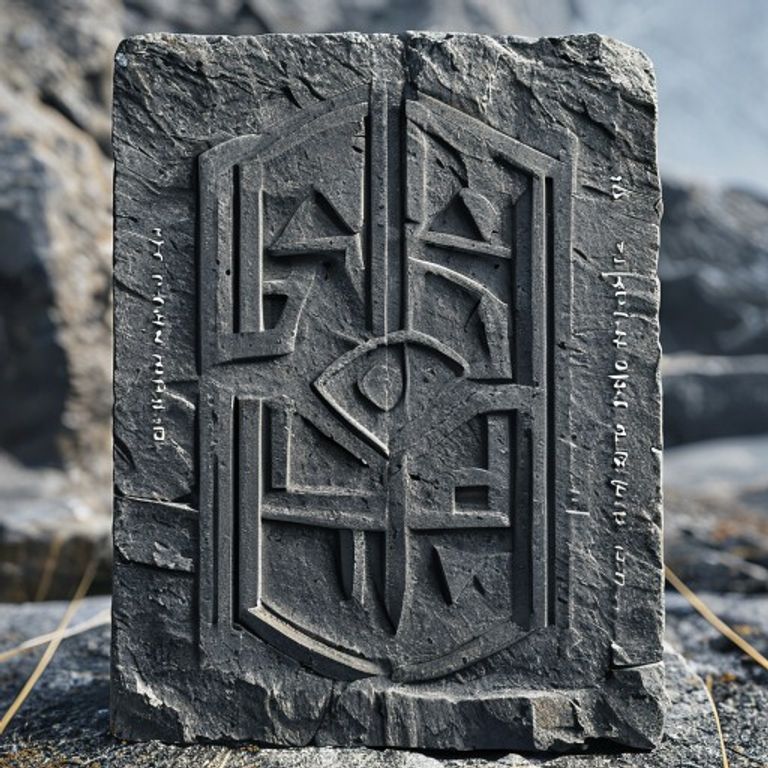
Once runes are selected, the practitioner must determine how they will be physically arranged and merged. Historical bind rune examples cluster into two primary architectural categories: linear stave forms and radial forms. Understanding both allows for an informed choice based on the symbolic nature of your working.
Linear Stave Architecture
Linear stave bind runes organise multiple rune forms along a single shared vertical axis — the stafr. The two most common variants are stacked (runes placed sequentially along the stave, sharing the central vertical line but positioned at different heights) and same-stave (runes merged so that shared diagonal or horizontal strokes are physically identical, eliminating redundant lines). The Viking Age personal name-staves found on runestones frequently use the same-stave technique to compress a name into an elegant personal mark. This architecture naturally produces a vertically elongated form, suggesting upward movement and directed focus — appropriate for intentions concerning growth, aspiration, and forward momentum.
Radial Architecture
Radial bind runes organise rune elements symmetrically around a central point, rotating the same base rune (or a small set of runes) through four, six, or eight positions. The Aegishjalmur (Helm of Awe) — documented in the Icelandic Galdrabók and later grimoires — exemplifies radial architecture at its most developed: eight Algiz runes (ᛉ) extended from a central hub in all compass directions, creating an omni-directional protective field. Radial architecture is appropriate for intentions concerning protection, containment, wholeness, and the establishment of a bounded sacred space.
| Architecture Type | Structure | Historical Examples | Best For |
|---|---|---|---|
| Linear — Stacked | Runes share vertical stave, placed at different heights | Kragehul lance shaft, personal name staves on runestones | Sequential intention, two-rune dialogues |
| Linear — Same-stave | Shared strokes merged, no redundant lines | Viking Age monogram staves, Gibu Auja bracteates | Compact, unified formulas with maximum symbolic density |
| Radial — Symmetric | Rune elements rotated around central point | Aegishjalmur (Galdrabók, c. 1600), Icelandic protective staves | Protection, containment, omnidirectional workings |
| Radial — Asymmetric | Multiple distinct runes arranged around a hub | Later Icelandic galdrastaves, Huld Manuscript staves | Complex multi-domain intentions, advanced composition |
Graphic Merging: Aesthetics, Harmony, and the Rules of Beautiful Composition
A bind rune should be beautiful. This is not an aesthetic preference — it is a functional principle rooted in the tradition. A symbol that is visually chaotic, unbalanced, or difficult to reproduce from memory does not serve as an effective focal point for meditative attention or intentional galdr. The Icelandic galdrastave manuscripts are remarkable for the graphic elegance of their stave designs: complex symbols that resolve into unified, readable forms rather than tangles of competing lines.
The primary rule of graphic merging is the elimination of redundancy. When two runes share a structural element — a vertical stave, a diagonal arm angled in the same direction, a horizontal bar at the same level — that element appears once in the final composition. Two instances of the same line do not strengthen the symbol; they clutter it. The practical consequence is that you must sketch your bind rune multiple times, identifying and removing duplicate strokes with each iteration until the final form contains only the minimum lines necessary to make all component runes legible within the composition.
The second rule is bilateral awareness. Some rune forms have mirror variants that are symbolically equivalent (Kenaz can open left or right; Laguz can face forward or backward in certain traditions), and choosing which orientation to use affects both the geometric integration of the stave and the potential hidden runes that appear in the negative space. Sketch your composition, then deliberately look for any rune outlines you did not intend — shapes that emerge from the intersection and overlap of your chosen runes. If an unintended rune appears, evaluate its symbolic register: does it support, oppose, or complexify your intention? For a deeper treatment of the hidden rune phenomenon and how to combine runes without symbolic conflict, see the dedicated guide. Adjust the composition accordingly.
The third rule is balance on the vertical axis. A bind rune that is visually heavier on one side than the other will feel unstable when used as a meditative focus. This does not require strict geometric symmetry — many historical staves are deliberately asymmetric — but the visual weight of the lines should resolve into a coherent whole. Practise drawing the completed stave freehand several times. If you consistently produce a slightly different form each time, the composition is not yet settled; rework it until it has the characteristic clarity of a form your hand remembers.
Practicum: Building the Classic Gibu Auja Bind Rune Step by Step
The Gibu Auja formula — Proto-Norse for "I give luck" or "I bestow good fortune" — is among the most archaeologically documented runic formulas in existence. The phrase appears carved on several Scandinavian gold bracteates dating to the 5th and 6th centuries CE, including finds from Seeland (Denmark) and other sites in the southern Scandinavian bracteate distribution zone. In these contexts, Gibu Auja functions as an explicit verbal gift: the carver, speaking through the object, offers luck to the wearer as a deliberate act. The bind rune form of this formula merges Gebo (ᚷ, position 7 in the Elder Futhark: the gift, the exchange, the principle of reciprocity) with Ansuz (ᚨ, position 4: the god-rune, divine breath, Odin's rune of inspiration and the spoken word). The resulting stave encodes the act of gifting divine inspiration and good fortune in a single, geometrically elegant form.
- Draw the central vertical stave. This is the shared axis on which both runes will be organised. Make it tall enough to accommodate the angular elements of both Gebo and Ansuz above and below the mid-point. Use a ruler or straight edge for precision in your working draft.
- Place Gebo (ᚷ) first. Gebo is an X-form: two diagonal lines crossing at the midpoint of the vertical stave. Draw the descending diagonal from upper-left to lower-right, then the ascending diagonal from lower-left to upper-right. These two strokes create the gift-exchange cross of Gebo precisely at the stave's centre.
- Add Ansuz (ᚨ). In its standard Elder Futhark form, Ansuz consists of the vertical stave with two diagonal branches extending upward and to the right from two points along the stave — resembling an F-rune mirrored, or an inverted v-shape applied twice. In the Gibu Auja stave, Ansuz's downward-pointing diagonals merge with the lower arms of Gebo's X, sharing those strokes rather than duplicating them.
- Identify shared strokes and eliminate redundancy. In the merged form, the lower two arms of Gebo's X and the lower branches of Ansuz occupy overlapping positions. Retain these as single strokes. The result is a stave with the central vertical axis, the upward X of Gebo visible in the upper half, and the full Ansuz readable in the lower half — all strokes serving double symbolic duty.
- Check for hidden runes. Examine the completed stave carefully. Common emergent forms in this composition include elements of Algiz (ᛉ) in the upper branching structure — an addition that many practitioners regard as beneficial (Algiz represents divine protection and connection), reinforcing rather than undermining the lucky-gift intent of Gibu Auja.
- Refine and finalise. Redraw the stave with clean, confident lines. The finished Gibu Auja bind rune should be recognisable as containing both Gebo and Ansuz while resolving into a unified visual form that your eye reads as a single symbol, not as two overlapping letters.
- Activate with galdr. To complete the working, speak the names: "Gebo — Ansuz" three times while tracing each stroke of the stave. Then speak the formula: "Gibu Auja" — I give luck — directing the breath into the completed symbol. This sequence mirrors the traditional three-stage activation: Rísta (mark), Rödja (make intentional), Galdr (voice).
Ready to compose your own bind rune? Use the interactive Elder Futhark canvas to select runes, arrange them on a shared stave, test different architectures, and export your finished design — built on the same principles as the 6th-century bracteate carvers.
Open the Bind Rune Canvas →Frequently Asked Questions
How many runes should I use in a bind rune?
Two to three runes is the optimal range endorsed by both historical practice and serious modern runology. Each additional rune exponentially increases compositional complexity and the risk of generating unintended "hidden runes" in the overlapping strokes. Viking Age amulets with confirmed bind runes almost universally combine two or three signs. Five runes is considered an absolute maximum, and only for practitioners with deep knowledge of each rune's geometric and symbolic footprint.
What is the Gibu Auja bind rune?
Gibu Auja is a Proto-Norse formula meaning "I give luck" or "I give good fortune," composed of the runes Gebo (ᚷ) and Ansuz (ᚨ) of the Elder Futhark. Archaeological evidence for this formula appears on gold bracteates and carved objects from 5th–6th century Scandinavia. In bind rune form, Gebo's X-shape is merged with Ansuz's branching diagonal to create a single stave encoding the act of gifting divine favour.
Does the order of runes in a bind rune matter?
Yes, both symbolically and geometrically. The rune placed on the central vertical stave typically acts as the primary principle; runes merged onto it act as secondary modifiers. Symbolically, the "lead" rune sets the dominant intention while the others qualify it. Geometrically, the order determines which strokes are shared and what "hidden" forms appear. Practitioners often sketch multiple arrangements before settling on the composition that best expresses the intended relationship between the runes' forces.
Can I make a bind rune from my initials?
Historically, personal name-bind-runes (monogram staves) were used as ownership marks and identity signatures on Viking Age objects. However, Elder Futhark runes are not a direct alphabet equivalent to modern Latin letters — each rune has a specific phonetic value and symbolic meaning. A bind rune made from name-initials works best when the chosen runes' symbolic meanings also align with the practitioner's intention, rather than treating them as pure letterforms.
What materials were historically used to carve bind runes?
The historical record shows Elder Futhark bind runes carved on a wide range of materials: wood (primarily yew and oak), bone, antler, various stones, gold and bronze bracteates, iron weapons, and fired clay. The Old Norse practice of ristir — the ritual cutting — emphasizes that the act of carving itself is part of the symbolic work. Modern practitioners use whatever medium they have access to, including paper for design work, before transferring to a permanent material.
How do I activate a bind rune I have designed?
The traditional activation sequence involves three stages: Rísta (carve or draw the symbol with full attention to each stroke), Rödja (make it red — historically with ochre or blood, symbolically with intentional colour), and Galdr (speak or sing the names of each component rune aloud, directing the sound into the symbol). Breathing Önd — a slow, deliberate exhalation onto the completed symbol — is the final act of binding the practitioner's life-force to the stave.